Shoppable UGC for Fashion Ecommerce Brands

Fashion ecommerce sells on fit, styling and trust, and studio product photography can only carry that so far. Foursixty turns your customers' Instagram and TikTok content into shoppable galleries on your online store, so shoppers see real people wearing the piece before they buy it.

Tag products in every post, manage usage rights, and track the online sales each gallery drives, on Shopify, Shopify Plus, BigCommerce, WooCommerce or Magento.

14-day free trial. No setup fee, no contract. Works with Shopify, Shopify Plus, BigCommerce, WooCommerce, Magento and custom storefronts.

Customer in a black ruched mini dress and over-the-knee suede boots Ruched mini dress $128
Customer on outdoor steps wearing a grey suit with lace-trim trousers and white platform boots Lace-trim trouser $145
Customer in washed black wide-leg jeans and a black crop top Wide-leg jean $98

Every tag links to the product page. Shoppers tap what they like and land on the item, ready to add to cart.

The buying barrier

Why Fashion Ecommerce Brands Need Visual Social Proof

Online fashion retail asks shoppers to commit to a garment they cannot touch or try on. The fashion ecommerce industry has grown into the largest category in retail ecommerce, but it also carries the highest return rates, and most of those returns trace back to a few doubts a product page failed to answer.

Fast fashion marketplaces like Shein compete on price and volume. Independent ecommerce brands win on confidence and customer experience: a shopper who has seen the dress on three real customers of different heights is far more likely to buy, and far less likely to send it back. Sustainable fashion labels face the same test, since a story about sustainability only converts once the shopper trusts the garment itself.

Fit and sizing
Studio shots show one body in one size. Customer photos show how the same piece sits on real people, which answers the question that drives most apparel returns.
Style confidence
Shoppers want to know how to wear it, not just what it is. Styling content from customers and influencers turns a single product into an outfit they can picture.
Fabric and texture
Drape, sheen and stretch rarely survive product photography. Video and unretouched photos show the material moving in daylight.
Trust in a new brand
Ecommerce sites live or die on trust signals. Real customers wearing the product are the most convincing signal a fashion ecommerce website can show.
Return rates and margin
Every avoided return protects margin on a category where shipping both ways can erase the profit on an order. Better pre-purchase information is the cheapest fix.

How it works

How Foursixty Helps Fashion Brands Turn UGC Into Sales

Foursixty is a social commerce platform built for the way fashion ecommerce brands already work. Your customers and influencers are producing content every day; Foursixty gives that content a job on your ecommerce store.

It replaces the manual loop of screenshotting Instagram posts, uploading them to a page and hoping someone finds the product, and it removes the guesswork about whether the content sold anything.

  1. Connect your content sources

    Connect Instagram and TikTok, plus your Shopify or other ecommerce platform catalogue. New posts, Reels, mentions and tagged photos flow in on their own, so a fashion brand with weekly drops never falls behind.

  2. Curate, tag products and secure rights

    Approve the posts that fit your brand, tag every item in the outfit, and request usage rights from customers with one comment. Rights and product links stay attached to the post wherever it appears.

  3. Publish shoppable galleries and measure

    Embed shoppable galleries on the homepage, collection pages, product pages, lookbooks and Klaviyo emails. Track clicks, add-to-carts and revenue for every post, and see which content earns its place.

Use cases

Fashion UGC Use Cases

These are the placements fashion brands on Foursixty use most, from women's fashion and swimwear to menswear, footwear and activewear.

Shop the look

Tag the top, the trousers and the shoes in one customer photo. Shoppers buy the outfit instead of the item, which is the simplest lever on average order value in apparel.

Real fit examples on product pages

A product page gallery filtered to that item shows it on customers of different sizes and heights, right beside the size selector where the decision is made.

Customer styling and lookbooks

Build seasonal lookbooks and landing pages from community content. Plus size, modest fashion, maternity and bridal shoppers can see the piece styled for them.

TikTok try-ons and hauls

Bring TikTok and Reels try-on videos onto the store so the fabric moves on screen. Here is how to add TikTok to Shopify without a developer.

Brands

See How Fashion Brands Use Foursixty

Foursixty powers shoppable galleries for apparel, footwear, swimwear, streetwear, activewear, lingerie, sustainable fashion and designer labels. A few of the fashion ecommerce brands running Foursixty on their storefronts:

23%+

of online revenue at Frankies Bikinis runs through Foursixty galleries, with 19% of total orders. Founder Francesca Aiello curates top-performing UGC into key on-site locations herself.

Read the Frankies Bikinis case study

+11%

average order value inside Babyboo's mobile app after making Foursixty UGC and Shop The Look the browsing experience, with 15% of total revenue now flowing through the app.

See more case studies

51x

return on Foursixty in MICHI's first 30 days after switching from a competing platform. The full activewear integration went live in half a day.

Read the MICHI case study

Examples

Shoppable Gallery Examples for Fashion Stores

A Foursixty gallery looks like part of your storefront, not a widget. Layouts, spacing, fonts and hover states follow your theme, and each tile carries the product tags, price and a direct path to the product page.

On mobile devices, where most fashion ecommerce traffic now arrives, galleries swipe like a social feed and open into a lightbox with every tagged item listed for purchase.

The same gallery can run on the homepage, a collection page, a landing page for a paid campaign, or inside a Klaviyo email, with the same tags and the same tracking.

Explore gallery layouts
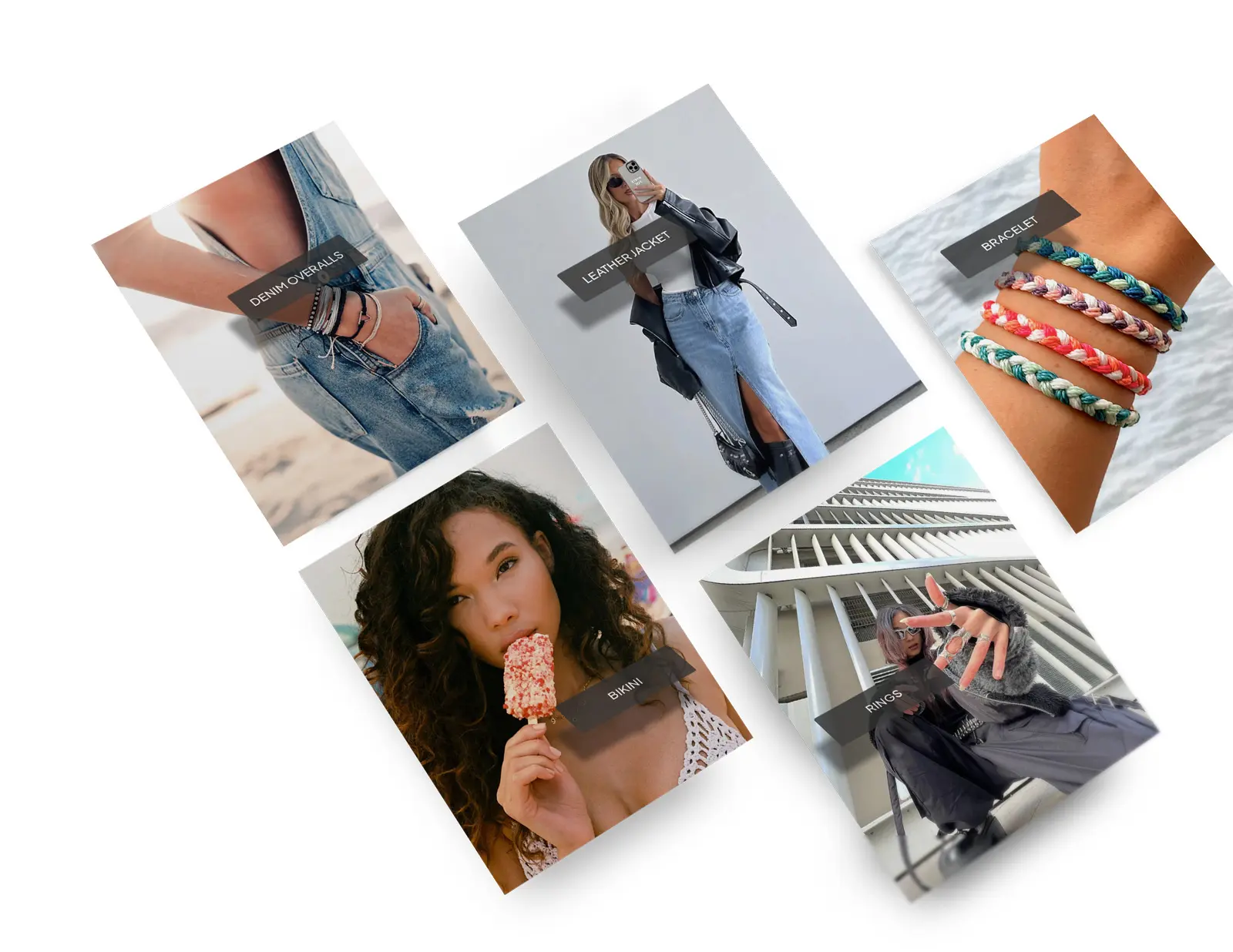
Shoppable gallery tiles showing denim overalls, a leather jacket, a bikini, bracelets and rings with product labels

Results

Revenue and Conversion Benefits for Fashion Brands

Shoppable UGC changes the numbers fashion ecommerce brands already watch. Conversion rates rise when the product page answers fit and styling questions. Average order value rises when a shopper can buy the whole look. Time on site and product discovery improve when the homepage feed behaves like a lookbook.

It also makes paid and social content work harder. A creator video that earned attention on TikTok keeps converting on the landing page long after the campaign ends, and a customer photo licensed once can serve in email, on the storefront and in ads.

Foursixty attributes clicks, add-to-carts and orders back to the gallery and the post, so you can read UGC revenue attribution the way you read any of your other sales channels.

23%+ of online revenue driven through shoppable galleries Frankies Bikinis, swimwear
+11% average order value with UGC and Shop The Look in the app Babyboo, fashion
17% of online revenue through Foursixty engagement, with bounce rate down 34% Pura Vida, jewelry
51x return in the first 30 days after switching platforms MICHI, activewear

Reported customer outcomes from published Foursixty case studies, not guarantees. Model your own numbers with the shoppable UGC ROI calculator.

Placements

Shoppable UGC Across the Customer Journey

Fashion shoppers rarely buy on the first page they see. Foursixty puts the right content at each step, from discovery to the cart and the follow-up email.

  1. Homepage

    A community feed that doubles as the season's lookbook and pulls new visitors into the catalogue.

  2. Collection and category pages

    Shoppable category galleries for dresses, denim, footwear or swim that show the range in use, next to site search and filters.

  3. Product pages

    Customer photos and videos of that exact item. This is where UGC on PDPs does its heaviest lifting on conversion and returns.

  4. Lookbooks and landing pages

    Campaign and influencer landing pages built from creator content, with every piece tagged so the page sells as well as it inspires.

  5. Cart and checkout

    Shop-the-look product recommendations from the same post the shopper came from, a natural place to complete the outfit.

  6. Email and paid media

    Dynamic UGC galleries in Klaviyo campaigns and abandoned-cart flows, and licensed customer content for paid social creative.

Platform

Foursixty Features for Fashion Ecommerce

Everything a fashion ecommerce team needs to run UGC as a sales channel rather than a side project, from the first Instagram import to the revenue report.

Foursixty fits alongside the rest of the stack: your ecommerce platform, inventory management, payment methods including buy now, pay later, personalized recommendations and email.

Works with your ecommerce platform

  • Shopify
  • BigCommerce
  • WooCommerce
  • Magento
  • Klaviyo
  • Squarespace
  • WordPress
  • Shoppable galleries

    Homepage, collection, product page, lookbook and landing page galleries that match your storefront, on desktop and mobile.

  • Product tagging

    Tag every item in an outfit, with size and colour variants, and send shoppers straight to the product page. Read how to add Instagram photos to Shopify product pages.

  • Rights management

    Request and track permission to use customer photos and videos before they appear on your store.

  • Moderation

    Approve, hide and order posts so only on-brand content reaches your customers.

  • Social content curation

    Pull in Instagram posts, Reels, TikTok videos, mentions and hashtags, then group them into galleries and campaigns.

  • Analytics

    See clicks, add-to-carts, conversions and revenue for every gallery, post and ambassador.

  • Ecommerce integrations

    Shopify app blocks, Klaviyo email galleries, Okendo reviews and an API for custom or headless storefronts.

Why Foursixty

Why Fashion Brands Choose Foursixty

Built for ecommerce, not just social

Foursixty started in 2014 as a shoppable Instagram tool for fashion and lifestyle brands on Shopify and has stayed focused on one job: turning social content into on-site sales. Product tagging, rights, moderation and revenue tracking are the core product, not add-ons. See why it ranks among the best social commerce platforms for ecommerce.

Fashion is where it started

Swimwear, womenswear, activewear and streetwear brands were Foursixty's first customers and remain its largest group. The workflows around drops, outfits, sizing and seasonal lookbooks come from years of that work, and our support team knows fashion PDPs as well as your merchandiser does.

Proof you can take to finance

Every gallery reports clicks, add-to-carts, orders and revenue. Ambassador and campaign tracking show which creators sell, and the free ROI calculator models the business case before you commit budget. It is how brands compare the best UGC content platforms on results rather than feature lists.

Fashion categories on Foursixty

  • Apparel
  • Women's fashion
  • Men's fashion
  • Swimwear
  • Footwear
  • Activewear
  • Athleisure
  • Sportswear
  • Streetwear
  • Luxury fashion
  • Designer fashion
  • Sustainable fashion
  • Plus size
  • Modest fashion
  • Maternity
  • Bridal
  • Formalwear
  • Lingerie
  • Underwear
  • Outdoor apparel
  • Workwear

Related industries

Shoppable UGC for Other Ecommerce Industries

Fit, texture, use and gifting confidence are different problems in every category. See how shoppable UGC applies in verticals close to fashion, or browse the full list.

Closest to fashion

  • Beauty & Cosmetics
  • Jewelry & Watches
  • Fitness & Sporting Goods
  • Lifestyle
  • Kids & Baby
  • Uniforms & Professional Apparel

All ecommerce industries

  • Beauty & Cosmetics
  • Jewelry & Watches
  • Fitness & Sporting Goods
  • Health & Wellness
  • Furniture & Home Decor
  • Home Improvement & DIY
  • Food & Grocery
  • Kids & Baby
  • Pet
  • Outdoor & Adventure
  • Electronics & Tech
  • Automotive
  • Lifestyle
  • Gifts & Personalized Products
  • Print-on-Demand & Custom Products
  • Art & Handmade
  • Books & Stationery
  • Flowers & Floral
  • Uniforms & Professional Apparel
  • Subscription Commerce
  • Direct-to-Consumer
  • Equestrian

More industry pages are on the way. The industries hub lists what's live.

FAQ

Fashion Ecommerce UGC FAQs

Questions fashion ecommerce teams ask about shoppable UGC, product tagging, rights management and how Foursixty fits their store.

Fashion brands connect their Instagram and TikTok accounts, collect customer photos and videos, tag the exact products worn in each post, and publish shoppable galleries on the homepage, collection pages and product pages of their online store. Shoppers see real people wearing the piece they are considering, click the tag, and land on the product page with a clearer sense of fit and styling. Foursixty tracks clicks, add-to-carts and revenue from every gallery so you can see which content sells.

Shoppable UGC is customer or creator content with products tagged inside the image or video. Foursixty pulls the content in from social channels, you approve what appears and tag the products, and the gallery embeds on your store with a snippet or a Shopify app block. When a shopper taps a tagged item they go straight to that product page, so the content becomes a merchandising surface rather than a decorative feed.

Yes. Product page galleries show only the posts tagged with that specific product, so a dress page displays customers wearing that dress rather than a generic brand feed. This is the placement with the most direct effect on add-to-cart confidence, and it works on Shopify, Shopify Plus, BigCommerce, WooCommerce, Magento and custom storefronts.

Connect the accounts once and Foursixty keeps importing new posts, Reels and TikTok videos automatically. From the moderation view you tag products, request usage rights from customers with a comment, and choose which galleries each post belongs in. The same content can then run on your site, in Klaviyo emails and in campaign landing pages without re-uploading anything.

Fashion ecommerce is the online sale of apparel, footwear and accessories through a brand's own ecommerce store, marketplaces such as eBay, or social commerce channels like Instagram and TikTok. It spans everything from fast fashion and streetwear to luxury fashion and sustainable fashion, and it is the largest category in retail ecommerce by sales volume.

The 3-3-3 rule is a capsule wardrobe exercise: pick three tops, three bottoms and three pairs of shoes and build every outfit for a period from those nine pieces. For an ecommerce brand it is a useful content prompt, because customers who show how one piece works across several outfits produce exactly the kind of styling content that converts on a product page.

The best fashion ecommerce websites share a few traits: fast mobile pages, honest fit and sizing information, product photography backed by real customer photos, straightforward returns, and payment methods shoppers expect, including buy now, pay later. Brands like Frankies Bikinis and Babyboo are strong examples of stores that make community content part of the shopping experience rather than a side feature.

Yes. Fashion ecommerce is a mature industry with established brands, profitable independents and a large dropshipping segment. Margins depend on product cost, return rates and customer acquisition cost, so the stores that last are the ones that convert existing traffic well and earn repeat purchases instead of buying every sale with ads.

For most apparel brands January and February are the slowest months, after holiday gifting and during heavy clearance. Late summer can dip as well before back-to-school and fall collections. Slow months are a good time to refresh product page content and build the UGC library you will lean on in Q4.

It can be, if you have a clear point of view and a plan for trust. Platforms like Shopify and BigCommerce have removed the technical barriers, so the differentiator is whether shoppers believe your product will look on them the way it looks in the photos. Brands that collect and display real customer content from day one build that trust far faster than brands relying on studio photography alone.

Apparel and accessories is the single largest category in U.S. retail ecommerce, with online fashion sales well above one hundred billion dollars a year and a growing share of total apparel spending moving online. Industry forecasts point to continued growth as social commerce and mobile devices carry more of the purchase journey.

The brands we work with consistently point to the same early lever: getting real customers on the site. Reposting customer photos to Instagram, tagging the products, and bringing those posts back onto product pages gave new stores social proof before they had hundreds of reviews. It also lowered product photography costs while the catalogue was still changing quickly.

Shopify developers help fashion brands go beyond a stock theme: size guides, shop-the-look sections, faster mobile pages and cleaner collection filtering. Foursixty is built to fit that work, with Shopify app blocks, theme extensions and an API, so a developer can place shoppable galleries exactly where they belong in the storefront.

A solid ecommerce platform such as Shopify Plus, BigCommerce, Magento or WooCommerce, an email platform like Klaviyo, site search and personalized product recommendations, inventory management, and a shoppable UGC platform that turns Instagram and TikTok content into on-site conversion. The common thread is technology that shortens the distance between inspiration and checkout.

Start with the product page: show the item on real people of different sizes, keep sizing information close to the add-to-cart button, make the gallery fast on mobile devices, and let shoppers see how others styled the piece. Customer photos answer the questions a shopper would otherwise ask a friend, and they reduce the guesswork that drives returns.

Focus on the moments where shoppers hesitate. Add customer photos and videos to product pages, use shop-the-look galleries to raise average order value, keep trust signals like reviews and returns policy visible, and test placements rather than guessing. Brands using Foursixty report double-digit shares of online revenue passing through shoppable galleries once the content is placed where decisions happen.

See How Foursixty Works for Fashion Brands

Bring your customers' photos and videos onto your product pages, tag every piece, and watch what happens to conversion rates and returns.

Book a demo
  or   Start 14-day free trial